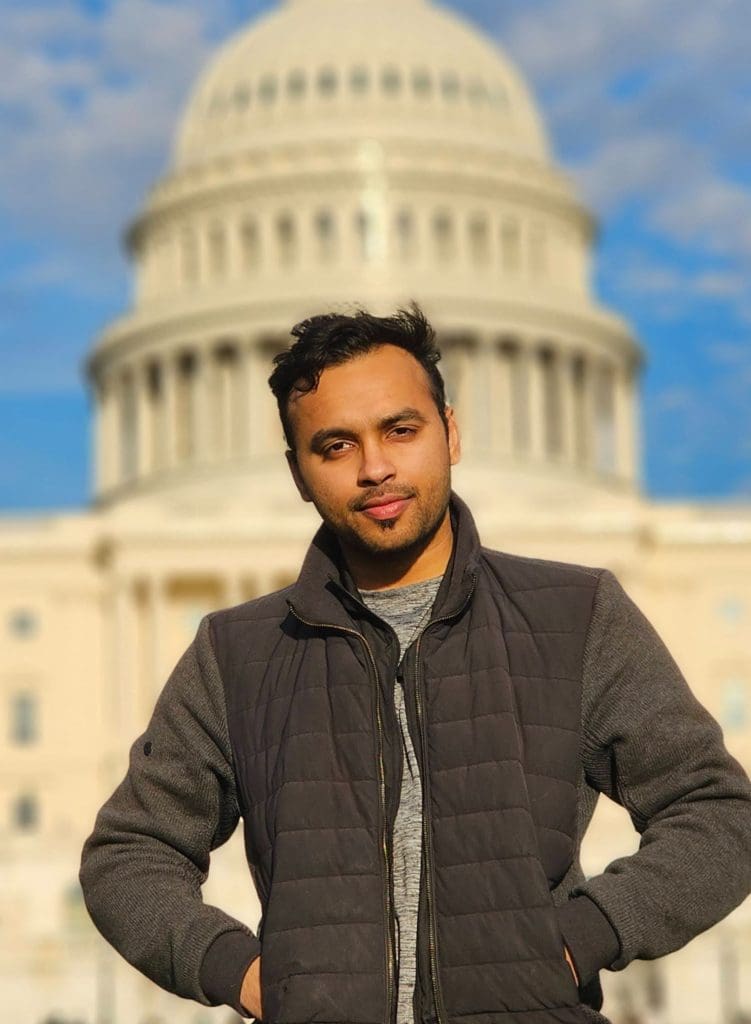
Cognitive Science PhD student Yash Mehta had quite a busy summer.
Yash, a member of the Cognitive Neuroscience & Deep Learning Group here at JHU, led by Professor Mick Bonner, spent the summer far from campus, completing an internship in Tokyo at Sakana AI before heading to San Francisco to participate in Y Combinator’s first-ever AI Startup School.
Here, Yash talks about his summer experiences, his research interests, and his research goals while completing his PhD here at Johns Hopkins.
You recently spent a portion of the summer completing an internship at Sakana AI. How was the experience?
At Sakana, I worked alongside PhD student interns from leading universities worldwide, all deeply passionate about their research. The environment was refreshingly free from corporate bureaucracy, offering genuine research autonomy to pursue topics that sparked our curiosity. Being based in Tokyo added another dimension to the experience—the city was incredible, especially during summer.
As my first research scientist internship, it exceeded expectations. I focused on LLMs for scientific idea generation, a departure from my PhD work that broadened my perspective on industrial lab priorities and methodologies. Beyond the research, we explored Japan extensively, and Sakana generously sponsored my trip to San Francisco for YC’s AI startup school – opportunities I’m grateful for.
What was a highlight of the experience for you?
The intern cohort was absolutely the highlight – about 20 of us, each bringing unique backgrounds and specialties. The diversity made for fascinating conversations, and exploring Japan together turned colleagues into great friends. Those shared experiences and connections were invaluable.
You mentioned attending the Y Combinator AI Start Up School this summer as well. What drove you to apply for this opportunity with Y Combinator?
I was drawn to startup culture, and YC represents the pinnacle for countless founders. The speaker lineup was extraordinary… It was an incredible convergence of AI and entrepreneurial leadership.
I wrote an entire blog [on] my YC AI SUS experience…
Can you share more about your research interests?
I develop computational models, specifically deep neural networks, to decode how the visual cortex processes information. My research focuses on comparing the internal representations formed by biological and artificial neural networks. The platonic representations hypothesis has revealed something remarkable: large-scale artificial models are converging toward unified representations across different modalities. Vision-only models and language-only models, despite their distinct training domains, develop strikingly similar representational structures. This convergence extends across diverse DNN architectures – the specific architectural choices matter less than we thought. What drives this brain-like alignment appears to be the training data itself, rather than the computational framework. Whether networks are trained through supervised learning, self-supervised approaches, or other objective functions, they achieve comparable alignment with neural activity patterns.
This principle captivates me because it suggests we’re approaching something fundamental about information processing. I aim to investigate whether biological neural networks exhibit these platonic representations and explore what this convergence reveals about the core computational principles shared between brains and artificial systems. This research could illuminate the universal algorithms underlying intelligence, both biological and artificial.
What do you hope to accomplish during your time in the PhD program in Cognitive Science here at JHU? What about after completion of your time in the program?
During my PhD, I want to build deep expertise across my research areas – DNNs, statistics, coding, and neuroscience. My goal would be to contribute in some way to novel human knowledge… I care about curiosity-driven research, though the publish-or-perish culture makes this tough sometimes. I’m grateful for this opportunity to study what fascinates me (doing a phd!). My supervisor, Mick Bonner, has been extremely supportive in giving me freedom to explore topics I’m genuinely interested in!
Post-PhD, I’m not entirely sure yet. I would like to do AI research at places like DeepMind or OpenAI, or even applied neuroscience work at companies like Neuralink.
Thank you for letting us know more about your summer opportunities and your research! Readers can view more at the links below.
The Department of Cognitive Science‘s Student Spotlight series exists to highlight our undergraduate, graduate, and post-doctoral student communities here at Johns Hopkins. Cognitive Science students interested in being featured can fill out this form for consideration: https://forms.gle/KM2DkSuNRJchfdfbA