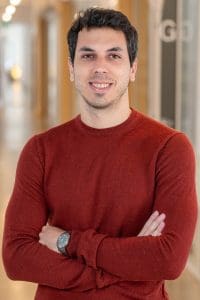
I came to Johns Hopkins because I was looking to do a master’s in cognitive science in order to try out research before committing to a full PhD. Given the reputation of the school, it was a no brainer for me once I was accepted.
Faculty mentors and research
Working with Mick Bonner was fantastic. He was a newer professor at the time and had lots of ideas and enthusiasm. I was also lucky to join at a time where the research directions of the Cognitive Science and Deep Learning Group lab were still in flux, and I was able to drive them given my own interests. The most rewarding part of the whole experience was when I was finishing up a project near the end of my masters and we made an accidental new discovery about the dimensionality of neural representations. It was so exciting that I actually came back to work on it after my masters as a full-time researcher, and it ended up blooming into one of Mick and the lab’s primary research interests.
Collaboration and new findings
I finished my master’s in August 2020, and started teaching at an online data science bootcamp during the pandemic. During that time, Mick and I were still working on submitting a paper on some work I did during my Master’s. When working on the paper, we stumbled across a new result that was more general and had potentially more significant implications for cognitive science and AI.
We wanted to find more time to develop this result, so we planned a one-year research assistantship back in his lab. We achieved our primary goal: develop our new preliminary finding on the high-dimensional structure of visual representations, and finish the academic year with a manuscript centered around this work. It took a couple more years to get it published in a journal, but the bulk of the research and writing was done during this productive one-year return to JHU.
During that time, I also got the chance to meet new lab members, collaborate with them on their projects, and work on some programming libraries with them for the cognitive science community.
Diversity of experiences
I had never done research prior to starting the master’s program, so it really was like stepping into the unknown. But in a year, I was shocked with how much I could learn. Looking back I did so much; research for the first time, graduate seminar courses, many class projects, and more. But I think my favourite aspect of the program was the sheer diversity of experiences I got. I was drawn to cognitive science because it blends so many different disciplines, from computer science to neuroscience, psychology, and linguistics. Outside of computer science, I knew little about any of these, but after a year I felt like I had excellent foundations in all of them.
Current AI research at MILA
At Mila – Quebec Artificial Intelligence Institute, I study models of high-level conscious cognition with an information complexity spin. In particular, I study the hypothesis that conscious cognition (e.g., thoughts) are compositional in nature: we form new conscious representations by building on top of existing ones. Part of this involves formally defining and quantifying what we mean by “compositional” information or representations, which has been one of my main focuses.
I now have a theory of compositionality that I think has big implications for AI, especially in regards to how an agent should structure their life experience in order to build a curriculum of data that enables the open-ended growth of compositional models.
Working with Paradigms of Intelligence
I’m also a part-time student researcher with Google on the Paradigms of Intelligence team. I work on a subteam that aims to build models that unify action (agency) with predictive sequence models. This relates to my projects at Mila, since the question is how to interact with the world as an agent in such a way that your predictive model of the world ends up being accurate (ie how to build a curriculum that collects good data).
I’m also working with another subteam there that studies a new theory of evolution that is deeply rooted in compositional structure, which again pairs nicely with my Mila work. I ended up getting involved with them because a number of professors at Mila, including one of my supervisors Guillaume Lajoie, have strong academic connections with members of the Google team.
While balancing both of my jobs is challenging at times, the Paradigms of Intelligence team works on exciting and forward-thinking projects that resemble the kind of ambitious work one finds in academia, so my roles actually blend more into each other than I would have expected!